Reaction-Diffusion
The Gray-Scott model, live in your browser. Nudge two numbers and watch nature's patterns emerge.
What is this?
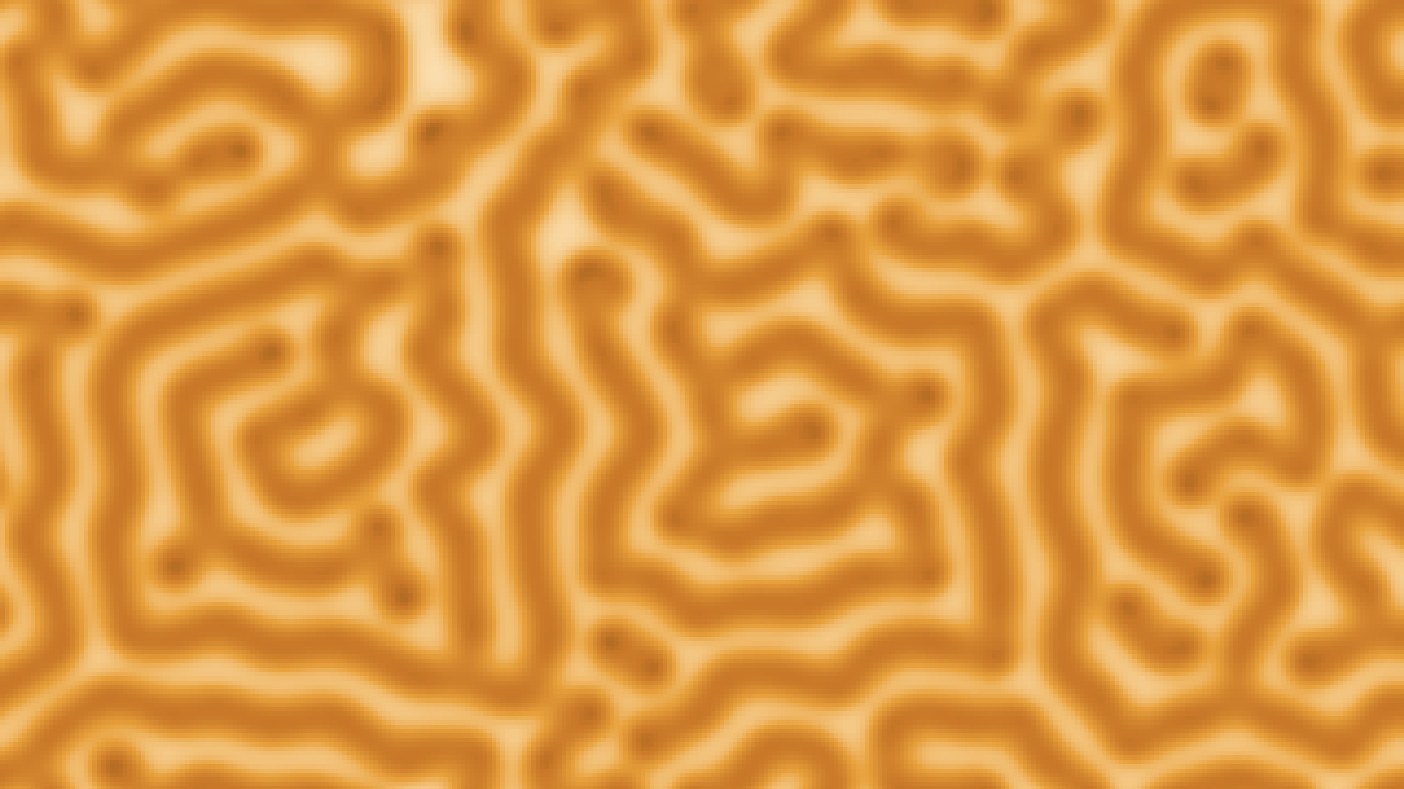
An interactive reaction-diffusion lab based on the Gray-Scott model: two virtual substances spread across a 220×220 grid and react by purely local rules, and out of that come spots, stripes, corals, mazes and spirals — the same kind of mechanism Alan Turing proposed in 1952 to explain patterns in living things (zebra stripes, leopard spots, coral ridges). Eight named presets map to documented regions of the parameter space, and you can also paint on the canvas with mouse or finger to seed the reaction by hand.
How it works
Two concentrations, A and B, evolve on a toroidal grid (the edges wrap around). Each step follows the autocatalytic reaction A + 2B → 3B, with B diffusing slower than A — short-range activation, long-range inhibition, the classic Turing recipe for why patterns appear instead of a flat gradient. Two sliders, feed (f) and kill (k), set how fast A is replenished and B removed; small changes flip the whole regime from dots to worms to mazes. It runs entirely in the browser — no install — in English and Spanish, following the site language with an in-app toggle.